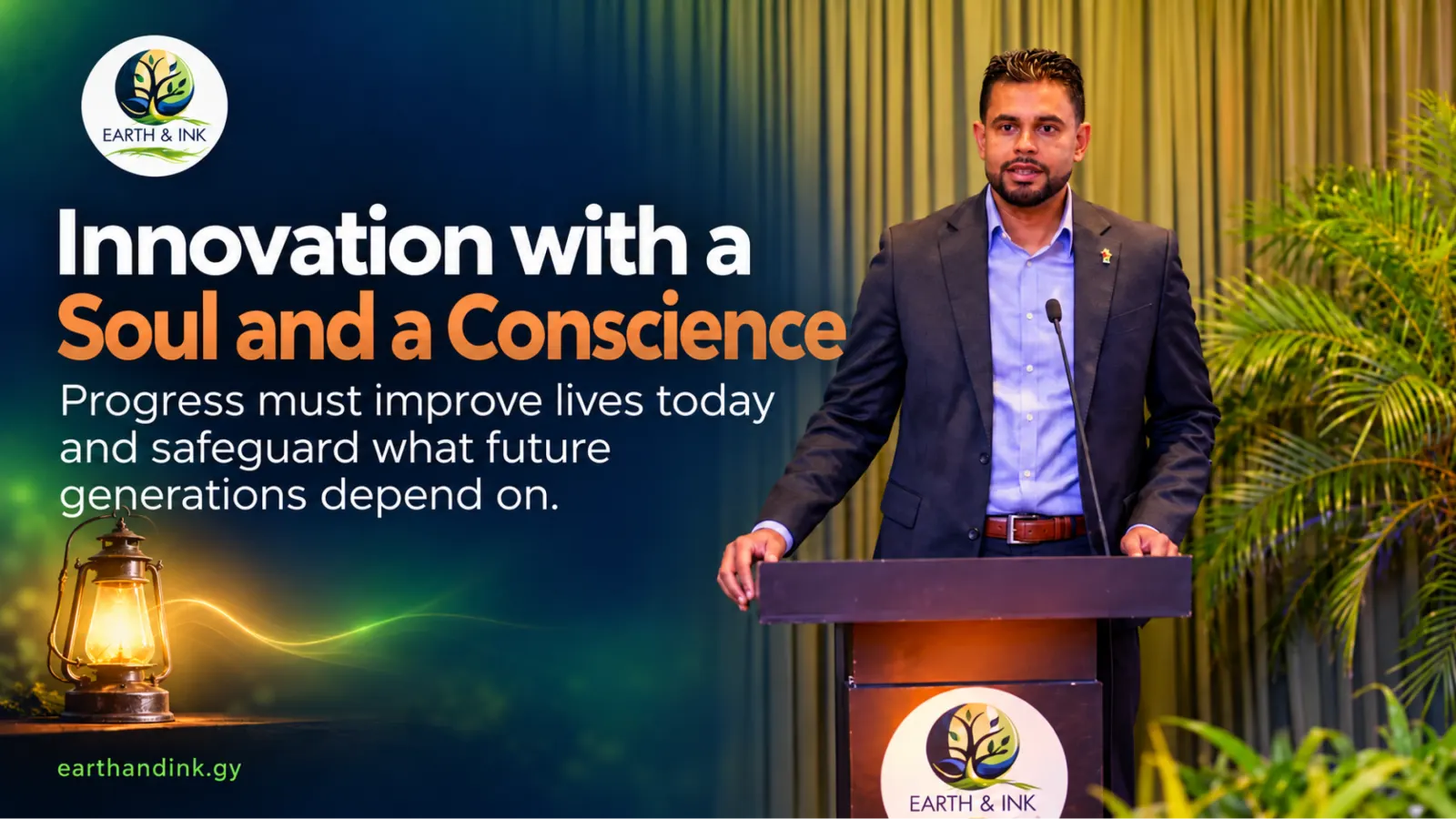
Drawing on his own experiences, Minister of Culture, Youth and Sport, the Hon. Charles S. Ramson Jr., in his Feature Address at Earth & Ink’s launch, connected the breadth of Guyana’s development to our everyday life. From his family’s gas lamp to his father’s harvest of pigeon peas, Minister Ramson’s stories explored how innovation improves the way we live and why those improvements must be accompanied by care for our environment and culture.
Earth & Ink, a Guyanese information platform focused on sustainable development and innovation, held its launch at Herdmanston Lodge in Georgetown on September 30, 2026. The event brought together government officials, private sector and academic representatives, and secondary school students. Ramson’s message carried particular relevance for the younger members of the audience, who will help shape Guyana’s development and live with the consequences of decisions made today.
How innovation becomes part of daily life
Pointing to the LED lights above the audience, Ramson recalled the gas lamp his family used during his childhood. Lighting it required a small mesh mantle, and the gas bottle needed refilling when it ran out. For his family, that lamp provided light throughout the room.
By tracing the progression from gas lamps to fluorescent lights, energy-saving bulbs and LEDs, he illustrated how successive improvements become part of ordinary life. The convenience of switching on a light, rests on knowledge developed and shared over generations.
“Innovation is the critical ingredient for the development of civilization,” he said.
Ramson connected that progress to the exchange of ideas. He stated that Guyana must remain open to people and knowledge from elsewhere while protecting its national interests. His message was that innovation grows when people can learn from one another and build on what already exists.
The example also reflected the purpose of the information platform: making a broad subject such as technological development understandable through everyday examples.
What development asks us to consider
Ramson then turned to sustainability, using another family experience to introduce the discussion. His father once spent an hour harvesting a large bag of pigeon peas and returned home delighted. His mother spent a further two to three hours shelling them, leaving a small usable quantity, which was valued at about the G$200 market price at that time.
He told the story with humour, reflecting on his parents’ experience of scarcity and the importance they placed on saving money. From that familiar household calculation, he moved to a wider point: the financial price of what we consume is only part of its cost.
“There is a price on the balance sheet, but there’s also a price to that, which is our earth, our home. So, everything that we consume, it ends up somewhere,” he said.
He was asking the audience to consider what consumption means for the environment, including the resources used and the waste left behind. As Guyana develops, the benefits of greater access to goods and services must be considered alongside those consequences.
“The development that we do in Guyana has a soul and a conscience. It must have a soul and a conscience,” he said.
That responsibility extended to culture. Ramson referred to the traditional childhood songs Carlvin Burnett had performed earlier at the launch, using them as an example of the shared experiences that carry Guyanese identity. He also spoke about protecting architectural heritage, including buildings shaped by the country’s climate and history.
Together, these examples reflected a hope for today’s tomorrow, our generations of now and the future: opportunities created by progress, alongside the environment and cultural traditions that make Guyana home. Minister Ramson closed with the shared aspiration that future generations could continue to enjoy “a beautiful earth and a beautiful home”.
Ramson’s contribution brought the themes of Earth & Ink’s launch into familiar settings: the household, the things we consume and the culture we share. These connections are central to our work, explaining how development happens and what it means for Guyana and its people.
Explore earthandink.gy for more on the connections between innovation, sustainability and the decisions shaping our country’s future.