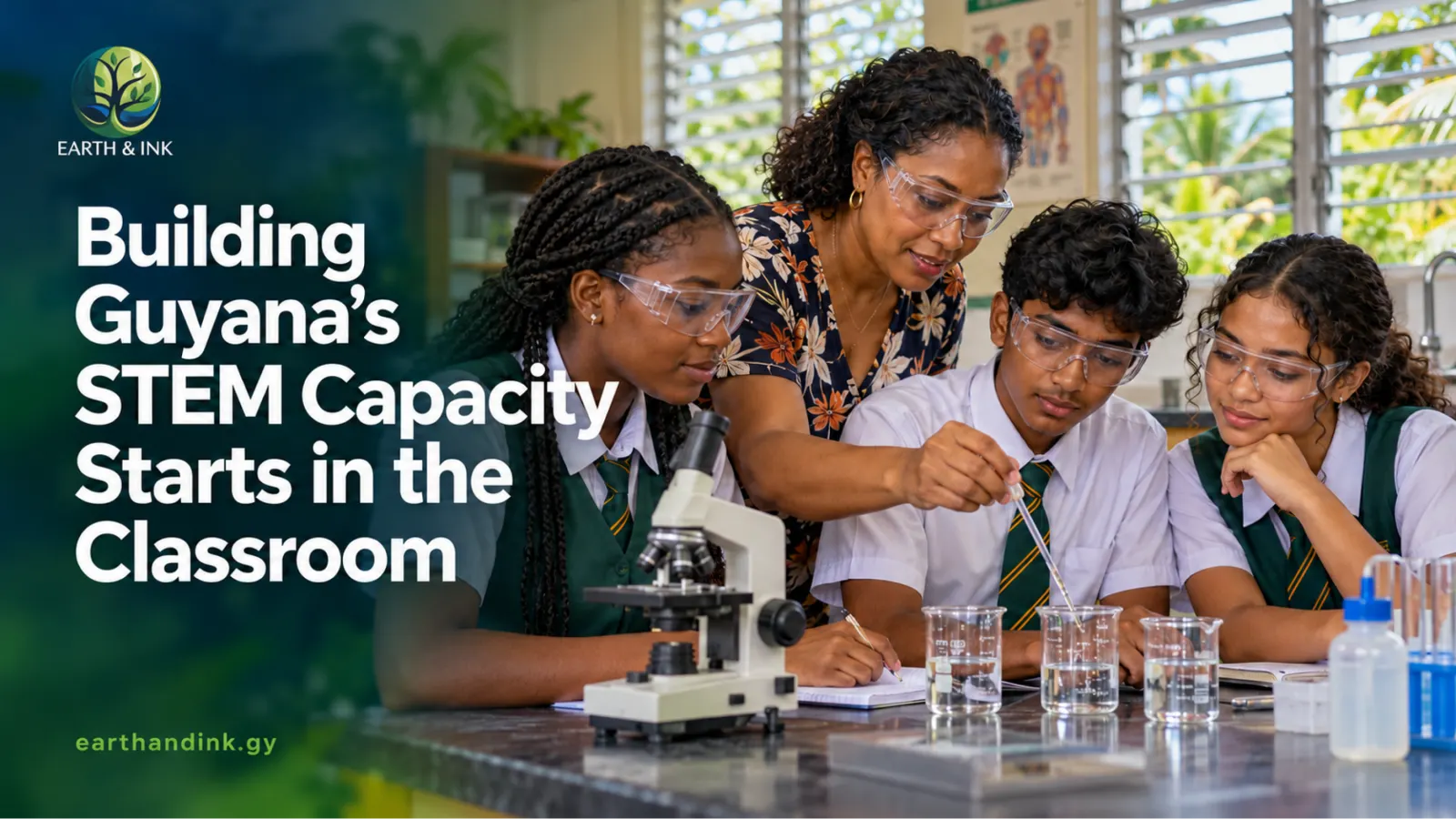
A science classroom may seem a bit removed from the larger questions surrounding Guyana’s development, but that couldn’t be further from the truth.
The country is expanding its energy sector, building new infrastructure, modernising agriculture, confronting climate risks and becoming more reliant on technology. Each of those shifts carries a less visible requirement: people with the technical knowledge and analytical capacity to operate systems, interpret evidence, investigate problems and develop solutions.
That places what happens in Guyana’s classrooms much closer to the country’s development story than it may initially appear.
The World Bank has identified skills gaps in Guyana as demand increases in growing industries, including agro industry and oil and gas. Its current education work also points to climate smart agriculture and digital technology among areas requiring closer alignment between education and the labour market.
STEM education, covering science, technology, engineering and mathematics, therefore has implications well beyond producing more scientists and engineers. It contributes to the wider base of technical, investigative and analytical skills that a changing economy increasingly requires.
And developing that capacity begins long before someone enters university or applies for a technical job.
Building capacity through teachers
The National Centre for Educational Resource Development, NCERD, through its Science Unit, conducts training, workshops and continuous professional development intended to strengthen teachers’ science knowledge and classroom practice.
According to information NCERD shared with Earth & Ink, this includes support in science content, laboratory and practical work, inquiry based learning, innovative teaching strategies and delivery of the science curriculum. The work is intended to strengthen teachers’ confidence and competence while expanding opportunities for students to engage in practical investigation, critical thinking, problem solving and collaboration.
That focus is consistent with Guyana’s broader education planning. The Guyana Education Sector Plan assigned NCERD’s Science Unit responsibilities that included strengthening science teaching methodologies, specialised training for secondary teachers, providing science resources and supporting demonstration lessons for teachers in hinterland communities. UNESCO also identifies professional development and teacher training among NCERD’s central responsibilities.
The emphasis remains visible. In September 2026, NCERD conducted curriculum training with teachers from public and private schools in Region Four, focusing on curriculum delivery, learning outcomes and teaching strategies. A month earlier, Guyana launched the Stellar STEM Associate Degree in Education at the Cyril Potter College of Education with an inaugural cohort of 62 students.
There is a straightforward reason that teacher development matters. Expanding practical and inquiry-based science requires more than laboratories and equipment. Teachers must also be equipped to use those resources effectively.
NCERD says its professional support extends across Guyana’s regions, including hinterland communities. The geographic dimension is significant. The World Bank has highlighted disparities in educational outcomes between coastal and hinterland communities, placing access to quality teaching within the wider human capital challenge.
Moving science from theory to application
Teacher capacity is one part of the equation. Students also need opportunities to apply what they learn.
NCERD’s National Laboratory Competition was introduced through its Science Unit as part of Guyana’s observance of World Science Day for Peace and Development. According to information provided to Earth & Ink, the initiative encourages secondary schools to develop and effectively use functional science laboratories while promoting practical approaches to learning.
The competition connects classroom theory with experimentation and scientific inquiry, while placing greater emphasis on the effective use of laboratory spaces. The Ministry of Education has also documented the competition as an NCERD initiative.
The National STEAM Fair broadens that approach. NCERD supports the wider Ministry of Education effort around the fair, which moves from regional competitions to a national platform where students investigate problems, develop projects and present their work.
In 2025, more than 210 projects were presented across Guyana’s 11 education districts before the national fair, covering areas including agriculture, environmental science, information technology, biology, chemistry, physics and industrial technology.
This is where STEM begins to move beyond curriculum content. Investigation requires students to interpret information, test ideas, communicate findings and reconsider an approach when the evidence does not support it. Those capabilities have applications well beyond the laboratory.
NCERD’s Women and Girls in Science activity addresses another part of the capacity question. According to information shared with Earth & Ink, the initiative provides girls with exposure to STEM opportunities and female role models while challenging perceptions of science and technology as predominantly male fields. It is intended to build confidence, increase awareness of STEM careers and encourage greater female participation in Guyana’s future scientific and technical workforce.
For a country seeking to expand its technical skills base, participation matters as much as preparation.
Guyana itself can become the laboratory
The connection between STEM education and national development becomes particularly clear through Sandwatch.
The UNESCO developed Sandwatch programme uses beaches and coastal environments as spaces for observation and investigation. Through its MAST approach, Monitoring, Analysing, Sharing and Taking Action, participants collect and interpret environmental information, communicate findings and consider responses to the conditions they observe.
Guyana’s Education for Sustainable Development Policy also identifies Sandwatch in relation to understanding coastline change, sea level rise and coastal erosion.
NCERD told Earth & Ink that its implementation in Guyana connects science and mathematics with issues including coastal change, pollution and climate impacts, while developing skills in measurement, data analysis, investigation and problem solving.
Here, the relationship between education and development becomes tangible. The coastline becomes a source of data, environmental change becomes something that can be measured, and science becomes a means of understanding a challenge unfolding close to home.
That matters for a country where questions surrounding coastal resilience, agriculture, energy, biodiversity, infrastructure and technology will increasingly require local technical expertise.
Guyana is investing heavily in the physical infrastructure of development. But infrastructure is only one form of capacity. Energy systems must be operated. Environmental changes must be measured. Technology must be adapted. Agricultural systems must become more resilient. Data must be interpreted and increasingly complex problems must be solved.
Someone has to be equipped to do that work.
The significance of STEM education therefore extends beyond science fairs, laboratories or individual careers. It is part of a longer investment in Guyana’s ability to understand, manage and eventually lead more of the technical work accompanying its development.
The results of that investment will not be measured in a single school year.
But the connection is already clear: the technical capacity Guyana will depend on tomorrow is being shaped, in part, by the quality of the science education available today.