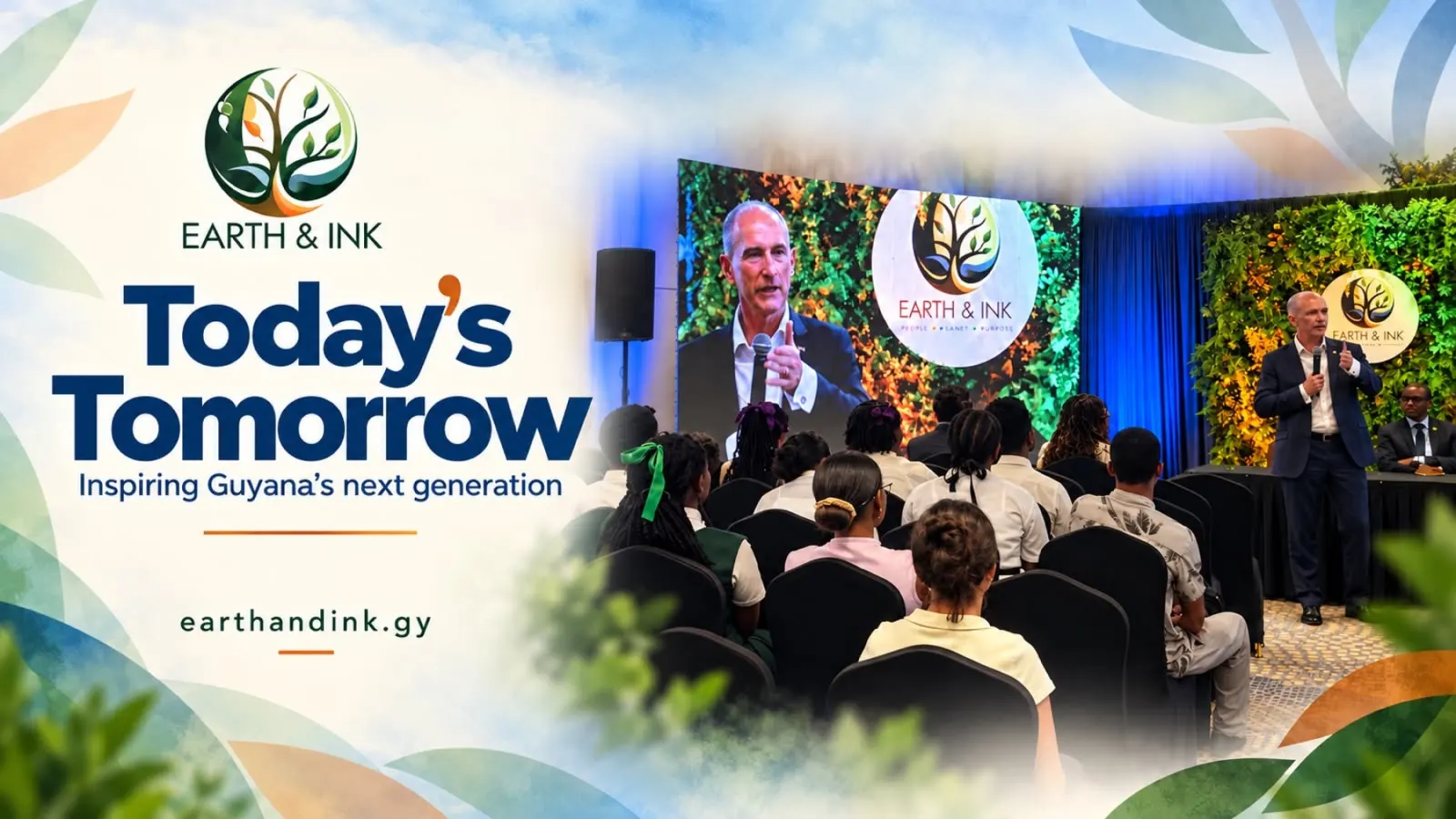
Alistair Routledge, President of ExxonMobil Guyana, had an affirming message for the students preparing to present their recommendations in the Future Leaders’ Challenge at Earth & Ink’s launch.
“The most valuable resource in the country isn't the oil and gas that we're known for producing; it's the people in the country,” he told them.
The students had been given four challenges rooted in science, technology, engineering and innovation on issues affecting community life: flooding after heavy rain, disposal of excessive garbage, protecting a damaged natural area while still allowing people to earn a living, and the need for reliable electricity alongside a cleaner future. Divided into four groups, they discussed their assigned question and chose representatives to present their ideas.
Earth & Ink’s Future Leaders initiative and the Future Leaders’ Challenge activity represent a part of our vision and purpose to intentionally include our students and young people in the conversations on Guyana’s development. Their ideas and choices will shape the country we become, and as an information platform and curated research hub, Earth & Ink aims to make knowledge accessible and useful, helping students understand Guyana’s evolving landscape and explore how they can contribute.
Routledge recognised that the questions before the students also reflected fundamental decisions facing communities.
“I was fascinated to hear the four topics that you're all working on and thinking about because these are really fundamental to that balance of how we as a society continue to develop and prosper and enjoy life, but at the same time manage our impact on the environment around us,” he said.
He encouraged them to see their involvement as something that could begin immediately.
“You have the opportunity in your lives to make a difference, starting today.”
Young people need opportunities to be involved, to test their ideas and support to put them into practice. A recent project at Skeldon Line Path Secondary School shows what that can look like.
Giving an idea room to grow
Fifth form student Randy Mangal identified problems with waste management and the condition of his school environment. Through SHOUT4Change, Guyana’s national youth environmental speech competition, he proposed an EcoHub that would make better use of the space and materials around him.
His winning proposal became a completed project through a partnership involving Recover Guyana, the Ministry of Education and ExxonMobil Guyana. As Guyana Chronicle reported on 1 October, the EcoHub includes furniture made from recycled materials, a hanging garden and a solar powered charging station.
Mangal’s idea about improving his surroundings was transformed into an environmentally friendly retreat for students and teachers. His experience gives practical meaning to Routledge’s message: young people can identify a problem and contribute to a solution, today.
The assigned question on the issue of waste, “Your school and community are producing too much garbage. What could you create, change or introduce to reduce waste and keep the area cleaner?”, also prompted Routledge to draw a connection to his own working day.
He shared that earlier that day, he had been discussing a waste management issue with members of his team.
“Where is it being generated from? How are we tracking it?” he asked, before discussing how to reduce the materials that become waste and adding, “How can we recycle?”
Routledge gave a practical example of recycling within ExxonMobil’s operations: “taking end caps off of pipes, shredding them, and putting them in a container and sending to the U.S. where we have a plant that can recycle plastic”. End caps are the covers fitted to the ends of pipes.
His account brought the students’ challenge into a professional setting, showing how questions about waste prevention and recycling also arise within petroleum operations.
Routledge’s pipe cap example showed one approach: collecting used plastic and preparing it for recycling. It provides a concrete starting point for a closer look at the processes and technologies ExxonMobil uses to manage waste from its petroleum operations.
For students, learning to develop such solutions starts with understanding materials, testing ideas and assessing what works. Teachers can help build those skills through practical science lessons that connect classroom learning to problems in everyday life.
In August, ExxonMobil Guyana launched STELLAR, providing specialised mathematics and science training through the Cyril Potter College of Education for an initial cohort of sixty trainee secondary school teachers. The two year programme includes laboratory experiences, practical learning and classroom practice.
It forms part of the company’s US$100 million, ten year Guyana STEM Initiative. STEM stands for science, technology, engineering and mathematics. The initiative focuses on teacher training, student opportunities and pathways into further education and careers.
For Guyana, its relevance lies in what that preparation could bring into a classroom: lessons that encourage children to investigate, test ideas and try another approach when something does not work. These are habits students could apply to the very challenges raised at the launch.
Who gets the chance to participate?
Access to those experiences matters too. Children need opportunities to discover their interests and develop their abilities.
At the 25 September launch of Phase 7 of Inclusive Innovators, former participant Mekyla Belgrave, who is blind, described learning coding, robotics and story creation. She also spoke about participating in a mainstream robotics competition, where her team received a special prize.
The programme, run by the Guyana Council of Organisations for Persons with Disabilities with ExxonMobil Guyana’s support, is intended in this phase to provide STEM training, including robotics, for 320 children with disabilities, alongside counselling and guidance for parents.
Belgrave’s account offers a personal view of what such access can mean: an opportunity to learn, discover an interest and participate in a competition alongside others.
At Earth & Ink’s launch, Routledge placed the students’ discussions within a responsibility that extends across generations.
“We need to do it in a way that preserves it for future generations,” he said of how people live and use the planet’s resources.
The challenge had asked students to consider that responsibility through problems they could recognise. His closing advice gave them a way to approach the size of the task.
“Don't be overwhelmed by the size of the challenges. Just think about how you can break it down.”
This advice applies beyond the classroom. It can describe how a student approaches a waste problem, how a teacher introduces a scientific concept or how a community begins responding to the changes required for development. Knowledge and support can help people find a practical place to begin.
ExxonMobil’s education and environmental programmes are one part of that process. Their value will emerge through the teachers equipped, the students engaged and the ideas put into practice.
At Earth & Ink’s launch, students put their minds to Guyana’s developmental challenges and the opportunities that solutions can provide. Through the EcoHub and a former participant’s experience of robotics, there are examples of what can happen when that potential receives support.
For our students, such opportunities can make the future feel closer: something they can explore, prepare for and begin shaping themselves.