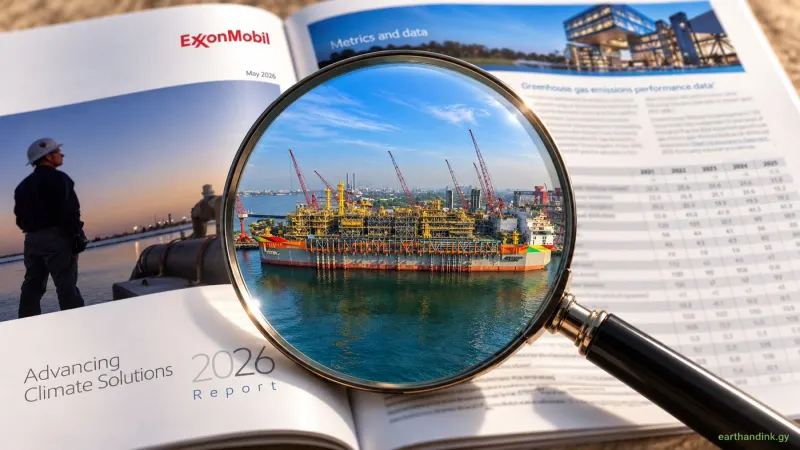
A gas pipeline at Wales, an airline buying forest carbon credits and a farmer preparing produce for export may seem to belong to separate stories. Yet each reveals something about how Guyana’s relationships with the wider world can reach into everyday life. The connection might take the form of electricity for a business, funding for a village project or access to a buyer beyond our shores.
Those connections ran through Minister of Finance Dr. Ashni Singh’s discussion with Kiana Wilburg on Starting Point. Behind the account of Guyana’s growing international influence was a practical question: what has to happen for that attention to become an opportunity people can use?
A different place at the table
Guyana’s international relationships once centered on a more immediate challenge: restoring the country’s ability to meet its financial obligations. Recalling the difficulties of the early 1990s, Minister Singh described years of institutional rebuilding, debt relief negotiations and financing on favourable terms. In his account, that work helped create the conditions for investment, including the exploration that preceded oil production.
By the 2026 Spring Meetings of the International Monetary Fund and World Bank, he described a different kind of engagement. Guyana was increasingly being approached for its views, experience and commercial possibilities, reflecting its rapid growth and greater contribution to the Caribbean economy.
For a local business, the significance of that change lies beyond the meeting room. Greater interest can bring potential partners with technology or expertise, investors willing to finance an operation and buyers looking for products. The value emerges through what those relationships help people build, produce and sell.
From global relationships to local value
Guyana’s forest carbon programme shows how that process can work. Standing forests provide a climate service, but earning revenue from it requires systems to measure the benefits, verify them against recognised standards and connect them with buyers. The original Low Carbon Development Strategy and partnership with Norway helped establish the foundation for the markets Minister Singh discussed.
The agreement announced with Hess in 2022 committed the company to purchasing at least US$750 million in carbon credits over several years. Each credit represents one tonne of carbon dioxide equivalent, a common measure for comparing greenhouse gases. The transaction pays for verified climate benefits; it does not transfer ownership of the forest.
Part of that international revenue is directed towards decisions made closer to home. Under the LCDS framework, 15% is dedicated to village-led plans for Amerindian villages and communities, while 85% supports national and multi-community programmes. A transaction negotiated with an overseas company can therefore help finance livelihoods, infrastructure and services within Guyana.
Airlines provide another connection. Minister Singh highlighted Guyana’s sales of carbon credits to 19 international airlines, which the Department of Public Information also reported in March 2026. Credits eligible for aviation emissions offsetting link demand from overseas carriers with the climate benefits of Guyana’s forests.
Guyana’s forests hold more than carbon. They support wildlife, freshwater systems and livelihoods, giving the country a stake in global decisions about protecting nature. The Global Biodiversity Alliance extends that role, reflecting Minister Singh’s view that small countries can offer approaches others can learn from. With the Biodiversity Summit taking place this Friday, the connection comes closer to home: how can international partnerships support conservation, strengthen community livelihoods and create space for young Guyanese to help shape those decisions?
At Wales, the relationship between a natural resource and everyday opportunity takes another form. Gas can supply electricity and support industries that depend on it. Minister Singh also outlined possibilities for further gas development in Berbice, including fertiliser manufacture, processing bauxite into alumina and petrochemical production. These remain prospects whose development would require further investment and infrastructure.
At Wales, those benefits depend on completing the work needed to bring electricity generation into service. A September 2026 update indicated that the first turbine was expected to undergo initial firing and testing in December, marking a step towards supplying power to businesses and households.
For agriculture, the connection runs from the farm to the buyer. Minister Singh identified Blumberg Grain’s involvement in the regional food hub as an example of international investment beyond petroleum. The partnership announced in July 2025 has been followed by construction activity, with a September 2026 government update placing substantial completion of the Yarrowkabra hub at year-end.
Its planned sorting, packaging and temperature-controlled storage facilities address a practical problem: growing produce is only useful commercially if it can reach a buyer in saleable condition. As the hub develops, those services could help farmers reach wider markets while creating demand for transport, packaging and maintenance.
Preparing to take part
These opportunities require preparation. A Guyanese company may bring personnel, capital and local knowledge while needing specialist expertise to deliver a contract. Partnerships can combine those strengths. Industrial development can also generate work beyond the main operation, reaching electricians, transport providers, maintenance workers and professional services.
For young people, Minister Singh’s advice is to build qualifications and experience while these areas develop. He identified the Guyana Online Academy of Learning, or GOAL, as one route. With 14,064 scholarship awards reported for 2026 across vocational, preparatory and degree programmes, that route continues to offer opportunities for further study.
For a farmer considering new markets, a business exploring a partnership or a student choosing a course, understanding this wider picture makes national development more tangible. Knowing what is already available, what is being built and what remains a possibility helps people decide where to direct their effort. That is where Guyana’s global standing begins to connect with everyday opportunity.